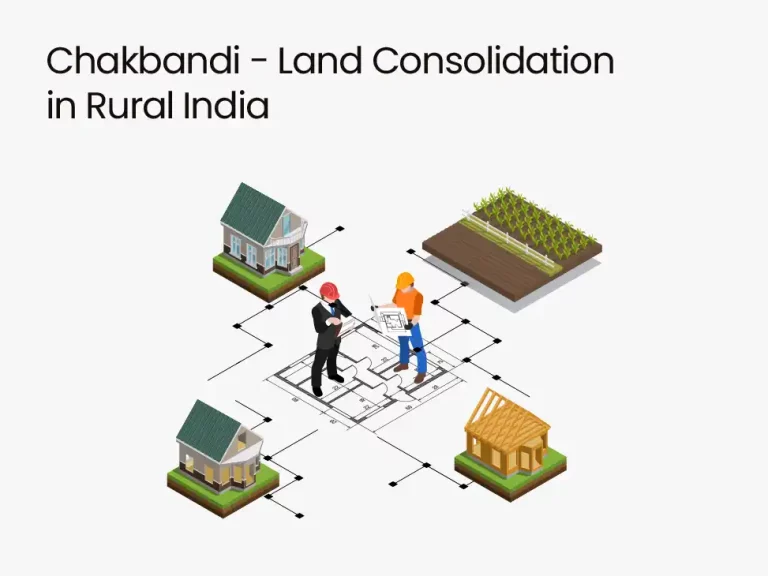
In rural India, especially in states like Uttar Pradesh, many farmers struggle with fragmented land holdings—small plots too scattered to farm efficiently. Chakbandi, literally “chak arrangement,” is the government‑led land consolidation exercise designed to merge those dispersed land parcels into compact, productive units. Instituted under the Consolidation of Holdings Act 1953, Chakbandi aims to improve productivity, reduce disputes, and enhance rural infrastructure. This blog explores what Chakbandi is, why it is important, how the process works, and its benefits and challenges using the latest data and case studies.
What is Chakbandi?
The term Chakbandi comes from Hindi: “chak” means a parcel of land, and “bandi” means arrangement or consolidation. Essentially, it refers to reorganizing fragmented land plots owned by a farmer into one or more consolidated “Chaks”—easier to manage and cultivate.
Legal Framework: The Consolidation of Holdings Act 1953
In Uttar Pradesh, Chakbandi is conducted under the Uttar Pradesh Consolidation of Holdings Act,‑1953 (UP Act No. 5 of 1954). This legislation provides the legal and administrative framework to combine scattered holdings into consolidated units while preserving land value and ownership rights.
Why Was Chakbandi Introduced?
Fragmentation of agricultural land is a persistent issue in India, where inheritance practices and fragmented sales result in scattered plots. It reduces agricultural efficiency, increases costs, and complicates irrigation and mechanization.
Goals of Land Consolidation
Chakbandi’s primary objectives include:
- Reducing land fragmentation and consolidation
- Increasing agricultural productivity
- Resolving boundary disputes
- Enhancing farm infrastructure like roads and irrigation
These benefits are collectively referred to as the concept of the importance of land consolidation in rural reform.
Historical Context & Spread of Chakbandi
Chakbandi was first launched in Muzaffarnagar and Sultanpur tehsils of UP in the mid-1950s. It proved successful and expanded statewide by the late 1950s. After that, no other Indian state fully implemented a statutory consolidation system like UP.
Today, thousands of villages in Uttar Pradesh have undergone the Chakbandi process. Estimates suggest nearly 4,500+ villages are under consolidation schemes currently.
The Chakbandi Process: Step by Step
Step 1: Village Selection
Authorities identify villages with scattered plots and initiate the exercise. Criteria include land‑dispersion patterns and potential impact.
Step 2: Survey & Mapping
Patwaris and surveyors conduct detailed mapping of all land parcels and record ownership, soil quality, water access, and existing features like wells and boundary trees.
Step 3: Community Consultation
Public village meetings (chaupal) are arranged where farmers learn about the process, valuation, and exchange proposals. Farmers can raise objections before final allocation. Consolidation officers and local elders act as mediators.
Step 4: Land Evaluation & Valuation
Each plot is assigned a value considering location, soil, and water access. Exchange ratios are formulated so that farmers receive land of equivalent value. Public land reserved for infrastructure like roads or schools also gets designated.
Step 5: New Allocation
Farmers are allotted new consolidated plots (Chaks) near each other and often closer to their homes. The layout reduces the number of distinct holdings and promotes efficient use.
Step 6: Record Updating
Ownership and boundary records (Khatauni, maps) are updated to reflect new parcel numbers and owner names.
Step 7: Final Settlement
Disputes raised during consolidation get resolved, and final land titles are issued. Farmers receive documentation for their consolidated plots.
Benefits & Importance of Chakbandi
- Enhanced Productivity: Compact holdings allow mechanization, reduce travel time between plots, and improve irrigation—all boosting yield and lowering costs. Farmers can adopt high-efficiency farming with ease.
- Reduced Disputes: Clear boundaries and unified plots reduce conflicts with neighbors over boundaries or water rights, minimizing legal cases and tensions.
- Improved Infrastructure: Post-consolidation, land allocation for infrastructure like chak roads, schools, and public land becomes more structured. Village-level planning improves communal amenities.
- Market Access & Value: Consolidated land is easier to lease or sell as a single unit. Larger contiguous farms are more attractive to buyers, boosting land values and marketability.
- Administrative Efficiency: Revenue authorities can manage records more effectively, collect better data, and reduce administrative overheads in land‑revenue management.
Challenges & Limitations
- Long Duration: Chakbandi exercises can take years or even decades. In some regions like Delhi, consolidation started in the 1970s and remains incomplete. Villages such as Nangli Poona, Kanjhawala, and others are still in limbo.
- Resistance to Participation: Farmers may resist due to mistrust, fear of valuation loss, or preference for traditional holdings. Delhi’s experience highlighted challenges in securing 80% village consent.
- Administrative Complexity: The process involves extensive surveying, dispute resolution, and legal amendments. Delays in mapping, staff shortages, and bureaucratic red tape hinder speedy completion.
- Balanced Value Exchanges: Ensuring every farmer gets equivalent-value land is complex. Soil variation, water access, and location differences require careful evaluation; otherwise, some may end up disadvantaged.
Chakbandi vs Land Consolidation Globally
Chakbandi reflects broader concepts of land consolidation, seen worldwide—in Europe, in Germany (Flurbereinigung) or France in the early 1900s. In many countries, redistribution improved mechanized farming and infrastructure planning. Demarcation, exchange, and valuation principles bear similarities.
However, India’s Chakbandi is a unique state‑led statutory exercise under legislation, rather than voluntary private consolidation. Uttar Pradesh remains the only Indian state with full statutory consolidation.
Impact of Chakbandi on Land Taxes
Chakbandi significantly improves the efficiency and transparency of land tax collection in rural areas. By consolidating scattered plots into unified land holdings, the tax system becomes more streamlined and accurate.
- Simplified Tax Collection: When a farmer’s land is consolidated, it becomes easier for revenue officials to assess and collect taxes. One or two contiguous plots are simpler to monitor than multiple fragmented parcels.
- Accurate Tax Records: Newly assigned land parcels during Chakbandi come with fresh tax assessments based on size, location, and value. This ensures that taxes are fair and reflect actual holdings.
- Fewer Disputes: Clear land boundaries and updated revenue maps reduce confusion among neighbors over plot ownership and tax liabilities.
- Increased Revenue for the Government: With transparent records and fewer discrepancies, local authorities can collect a higher percentage of due taxes without prolonged disputes or legal delays.
Chakbandi vs. Cadastral Surveying: A Quick
Feature | Chakbandi (Land Consolidation) | Cadastral Surveying |
|---|---|---|
Purpose | Improve land use by reorganizing fragmented holdings | Record legal boundaries of existing individual plots |
Process | Involves public consultations, objections, and reallocation of plots | Uses tools like chains, theodolites, or GPS for mapping |
Outcome | Consolidated land parcels, new plot numbers, improved communal layout | Creation of detailed land boundary maps and records |
Dispute Handling | Resolved through village-level hearings and consolidation officers | Typically handled post-survey through formal legal routes |
Digitalization of Chakbandi Land Records
As of 2024, over 98.5% of rural land records in India have been digitized, including records related to Chakbandi. This digital transformation brings several advantages:
- Easy Online Access: Farmers can check their land details on portals like UPBhulekh in Uttar Pradesh, improving transparency and accessibility.
- Reduced Fraud: Digitized records minimize tampering and illegal land transfers, curbing corruption.
- Faster Processing: Online systems handle changes like ownership updates or mutation requests much faster than traditional paperwork.
- Certified Copies Still Offline: Although most records are online, certified copies still require a visit to the local Tehsil office.
How Chakbandi Promotes Efficient Irrigation
Chakbandi isn’t just about land distribution—it also plays a pivotal role in improving rural water management and irrigation infrastructure.
- Improved Infrastructure Development: Once land is consolidated, farmers can collectively plan and develop irrigation canals, bore wells, and tube wells.
- Less Water Wastage: Continuous plots allow smooth water flow from one field to another, avoiding the inefficiencies of irrigating scattered parcels.
- Shared Costs: Consolidated land allows for joint irrigation systems, helping farmers split expenses related to pumps, pipelines, and electricity.
- Smarter Crop Planning: Farmers can now coordinate crops based on consistent water availability across their unified plots.
Role of Technology in Chakbandi Record-Keeping
Modern technology is transforming how Chakbandi records are created, stored, and maintained:
- GPS & Satellite Mapping: Advanced tools help generate accurate land maps, reducing human errors and preventing boundary disputes.
- Mobile Apps: Platforms like Landeed allow farmers to access their documents digitally, minimizing visits to government offices.
- Cloud-Based Storage: Records are securely stored online, making them immune to damage from natural disasters or data loss.
- Automated Updates: Any changes in ownership or land configuration are automatically reflected in the system, ensuring accuracy.
Current Status & Future of Chakbandi in India
Currently, Uttar Pradesh remains the only state actively conducting Chakbandi under the legal framework of the Consolidation of Holdings Act, 1953. As of 2025, over 4,497 villages in UP are undergoing or have completed land consolidation. The success of this initiative has prompted other states to consider similar programs.
Looking ahead, the future of Chakbandi appears promising, thanks to:
- Growing support from government policy
- Integration of GIS and mobile tech
- Demand for efficient land use and irrigation
- Emphasis on formal land records for credit access and legal clarity
If scaled across India, Chakbandi could be a game-changer for land reforms, agricultural productivity, and rural development.
Chakbandi, the Indian form of land consolidation, remains one of the most impactful rural reforms in Uttar Pradesh. Introduced under the Consolidation of Holdings Act 1953, it addresses land fragmentation and consolidation challenges by reorganizing farm holdings into manageable, contiguous parcels. Despite administrative challenges and long durations, the benefits—boosts in productivity, reduction in disputes, and better rural infrastructure—make it a cornerstone of agrarian reform. As digital tools and renewed policy interest emerge, the future of Chakbandi looks promising for transforming rural land use in India.


