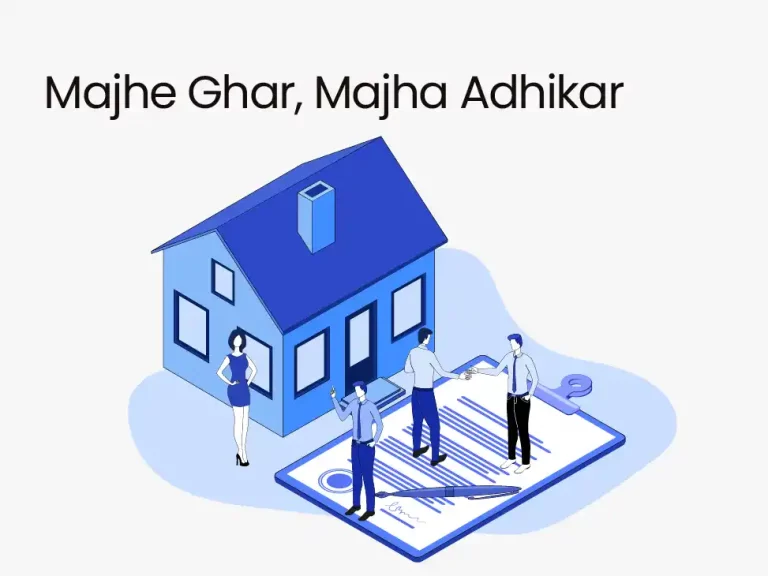
The Maharashtra government launched its new housing policy 2025, Majhe Ghar, Majha Adhikar (My Home, My Right) on May 20, 2025. This new housing policy by the Maharashtra government aims to provide affordable, sustainable, and inclusive housing to various sections of society. The policy focuses on transparency, real-time monitoring, and accountability and leverages IT-based systems to track beneficiaries, monitor project progress, and manage funds effectively. This marks a significant update, as the previous housing policy in Maharashtra was last introduced 18 years ago, in 2007. Majhe Ghar, Majha Adhikar targets constructing 35 lakh affordable homes by 2030 with an investment of ₹70,000 crore, setting a bold vision for urban development.
Majhe Ghar, Majha Adhikar: Vision and Objectives
The core objective of the policy is to ensure housing for all by 2030. The government plans to achieve this by:
- Constructing 35 lakh affordable homes by 2030
- Utilizing ₹70,000 crore in investments
- Promoting inclusivity by catering to various segments, including Economically Weaker Sections (EWS), Low-Income Groups (LIG), senior citizens, working women, students, industrial
- workers, and other marginalized communities
- Implementing sustainable and disaster-resilient construction practices
- Enhancing transparency and accountability through digital governance
Suggested read: YEIDA’s Plot Scheme
Key Features of the Majhe Ghar, Majha Adhikar Policy
1. Affordable Housing Initiatives
The policy prioritizes the construction of affordable homes for the EWS and LIG categories. Key initiatives include:
- Rent-to-Own Models: Allowing working women, students, and industrial workers to occupy homes for up to 10 years with the option to purchase them thereafter.
- Affordable Rental Housing: Developing rental housing near major hospitals for patients’ families and near employment hubs to reduce commute times.
2. Self-Redevelopment Support
To rejuvenate aging housing societies, the policy introduces:
- ₹2,000 crore allocation for self-redevelopment projects.
- Dedicated Cell to assist cooperative housing societies with planning, funding, developer selection, and project execution.
3. Government Land Bank
The government aims to create a land bank for residential use by 2026, coordinated across various departments. This initiative will:
- Reduce land acquisition hurdles.
- Ensure the availability of land for affordable housing projects.
4. Walk-to-Work Housing
Supporting the ‘Walk-to-Work’ concept, the policy mandates that 10–30% of land designated for amenity plots in industrial areas be reserved exclusively for residential use. This will:
- Promote housing near employment hubs.
- Enhance the quality of life by reducing commute times.
5. Slum Rehabilitation and Redevelopment
The policy emphasizes slum rehabilitation through a cluster redevelopment approach, including:
- Tripartite agreements between housing societies, developers, and authorities.
- Incentives for developers to undertake redevelopment projects.
- Formation of a state-level grievance redressal committee to monitor project delays and mediate disputes.
6. Sustainable and Climate-Resilient Housing
To combat climate risks, the policy promotes:
- Green building practices include thermal-resistant materials, rooftop gardens, and energy-efficient infrastructure.
- Incentives for eco-friendly construction materials.
- Promotion of solar energy, rainwater harvesting, and waste management.
7. Digital Governance and Transparency
The policy introduces the Maha Awas Portal, a centralized digital platform powered by artificial intelligence. This portal will:
- Integrate data on housing demand and supply.
- Coordinate with systems such as MahaRERA, Mahabhulekh, and PM Gati Shakti.
- Monitor fund allocation and district-wise land acquisition.
- Ensure transparency in beneficiary selection and project execution.
8. Inclusivity and Special Housing Schemes
Recognizing the diverse needs of its population, the policy includes special housing schemes for:
- Senior Citizens: Incentives for senior living projects, including reduced stamp duty and relaxed norms for Floor Space Index (FSI) and taxation.
- Students: Development of student housing near educational institutions.
- Differently-abled Persons: Inclusive housing designs catering to accessibility needs.
- Journalists, Artists, Freedom Fighters, and Mill Workers: Special provisions to honor their contributions.
- Industrial Workers: Affordable housing near industrial zones to promote the ‘Walk-to-Work’ model.
Suggested read: GPRA Housing Scheme
Expected Real Estate Impact of the New Maharashtra Housing Policy 2025
The implementation of this policy is expected to:
- Increase the affordable housing stock in the state.
- Revitalize aging housing societies through self-redevelopment.
- Reduce slum areas via cluster redevelopment.
- Promote sustainable urban development through green building practices.
- Enhance transparency and accountability in housing projects.
- Improve the quality of life for residents by reducing commute times and providing access to amenities.
Majhe Ghar, Majha Adhikar is Maharashtra’s new housing policy that marks a significant step towards addressing the state’s housing challenges. By focusing on affordability, inclusivity, sustainability, and resilience, the policy aims to provide housing for all by 2030. The comprehensive approach, including self-redevelopment support, government land utilization, walk-to-work housing, slum rehabilitation, and digital governance, sets a robust framework for urban development in the state.