When you need substantial funds to buy another property, expand your business, fund higher education, or tackle any unexpected costs, the equity locked inside your house is often your greatest financial ally. But before a financial institution hands over a significant sum of money, it must answer a pivotal question: how much is this asset truly worth?
Property valuation acts as the ultimate balancing mechanism in secured lending. It ensures that your underlying asset provides adequate security for the lender while helping you unlock its maximum financial potential safely, transparently, and responsibly.
In this blog, we will discuss what a collateral loan is and the ways banks value property for collateral loans.
What is a Collateral Loan?
Banks, as well as non-banking financial companies, offer two kinds of loan facilities: secured loans and unsecured loans. A collateral loan is a secured loan where the borrower has to pledge an asset just to get the loan. That pledged item, referred to as collateral, can later be sold off or liquidated by the lender if the borrower doesn’t keep up with repayments.
Meanwhile, unsecured loans do not ask the borrower to provide any collateral. So, because the lender can’t really grab an asset if things go wrong, these unsecured loans typically come with more expensive interest charges and quite strict eligibility criteria for creditworthiness.
When you opt for collateral loans on property, your asset stays entirely in your possession and daily use. The bank merely places a legal charge or mortgage on your property title deeds until the entire outstanding loan balance is cleared. These home collateral loans offer a reliable financial safety net because they provide higher loan amounts, lower interest rates, and longer repayment tenures than unsecured personal loans.
Different Ways Banks Value Property for Collateral Loans
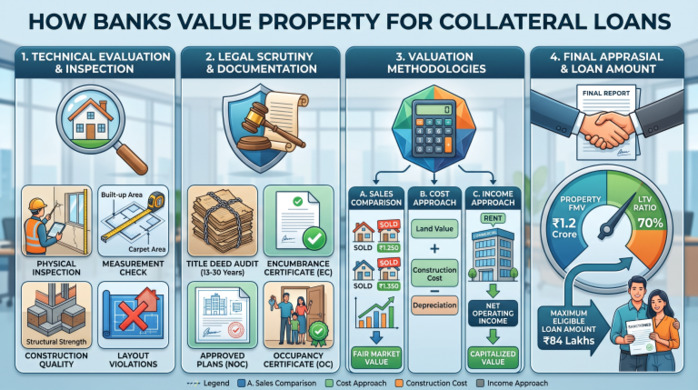
Before approving your home loan application, lenders deploy certified external legal and technical experts to evaluate your asset from multiple dimensions. Here is a breakdown of the specific valuation methodologies that banks and NBFCs perform to calculate your property’s final market worth:
Sales Comparison Approach
Lenders analyze recent transaction records of highly similar properties within your immediate neighborhood. Evaluators make sharp adjustments for property size, built-up area differences, structural age, and specific amenities to establish a baseline fair market price.
The Cost Depreciated Method
This technique calculates the exact capital required to reconstruct your entire building from scratch using current market material and labor rates. The expert then subtracts accumulated structural depreciation based on the age of your property.
Income Capitalization Valuation
For commercial layouts or residential blocks that generate consistent rent, banks value the property based on its future income potential. They capitalize the net operating income to see how much steady cash flow the asset yields.
Guideline Value or Circle Rate Analysis
Every state government publishes mandatory minimum registration prices for land, known as circle rates. Lenders strictly verify that the property’s value does not drop below this official benchmark during evaluation
Physical and Structural Inspection
Technical inspectors will come to your site to check whether the construction materials are solid, the architectural layouts look right, and whether there are signs of structural damage. Things like wall dampness, visible cracks, and the sturdiness of the foundation mostly affect the final valuation score.
Legal Title Deed Scrutiny
Legal teams meticulously audit your property’s ownership timeline over the past 13 to 30 years. They verify absolute ownership, chain of deeds, and ensure there are no active family disputes, pending litigation, or hidden third-party claims. It ensures them that there’s nothing shady from some separate party that could pop up later.
Encumbrance Certificate Verification
Banks cross-reference records with the local sub-registrar’s office to fetch an Encumbrance Certificate. This document proves the asset is entirely clear of existing monetary liabilities, unpaid municipal taxes, or previous active mortgages.
Locality and Infrastructure Assessment
Your geographical coordinates matter immensely. Properties situated near major highways, upcoming metro corridors, prominent business hubs, top-tier schools, and well-maintained civic amenities naturally secure a premium valuation and higher loan eligibility.
Demographics and Environmental Vulnerability
Lenders study local terrain safety and surrounding community trends. If a property lies in a low-lying, flood-prone zone, an industrially polluted belt, or an unstable neighborhood, banks apply safety haircuts to minimize future risk.
Navigating the Challenges of Bank Valuations with BASIC
Navigating the complex maze of physical inspections, legal paperwork, and deep technical parameters can quickly become overwhelming for property owners. At BASIC Home Loan, we remove the friction and anxiety from your borrowing journey by digitizing and streamlining the entire collateral evaluation workflow from start to finish.
We line up your unique property profile with the right banking partners, so you can push for the best loan-to-value ratio available. Our assigned financial advisors help you along the way through paperwork prep, property condition evaluations, and the legal clearance steps. We make sure you pull out the absolute maximum value from your asset, with zero hidden surprises, and no last minute issues.


