When life throws a major financial pitfall, like consolidating debt or pushing ahead with higher education, the answer becomes tough. In India, a “Loan Against Property” or LAP is what people call unlocking the hidden equity from a property you already have. If you’ve never stepped into secured lending before, you may feel a bit overwhelmed because you’re thinking about how to get a mortgage loan without ending up tangled in endless paperwork. The good news is that the process is pretty simple once you know the way lenders judge your assets and your income profile. Let’s walk through the whole thing, from the very first day to final disbursement, so you can apply with real confidence.
Demystifying the Basics: What Determines Your Eligibility?
Before jumping into the application process, let’s tackle that single most important question every property owner asks right at the start: how much mortgage loan can I get? There is really no single universal number, because financial institutions end up evaluating your application through two separate lenses. On one side, it’s the market value of your property, and on the other side it’s your income steadiness, meaning how consistently you can repay. For property loans, the LTV usually lands in the range of 50% to 75% of your asset’s current fair market worth, depending on circumstances. For instance, if a certified independent evaluator puts a price tag of ₹1 Crore on your property, you can realistically assume a loan amount somewhere around ₹50 Lakhs to ₹75 Lakhs.
However, a bank won’t approve the entire sum unless your monthly salary or business net profits clearly indicate that you can handle the monthly EMIs with ease. Lenders basically look for some reassurance that your cash flow is steady, so the debt gets serviced comfortably without any strain.
The Step-by-Step Application Roadmap
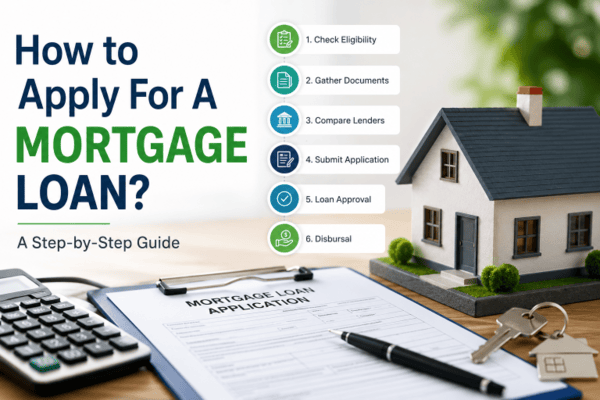
Ready to unlock your property’s value? Here’s how to apply for a mortgage loan:
- Gathering Income and KYC Documents
Your first move is pulling together your baseline documentation. Lenders require you to be a resident of India, aged between 21 and 65 years. You will need standard KYC documents (PAN card, Aadhaar) along with absolute proof of income. Salaried applicants need three months’ salary slips and six months’ bank statements. Self-employed business owners must provide audited balance sheets and Income Tax Returns (ITR) from the last two to three years.
- Submitting Your Property Records
This is the core of your loan against property. You must submit the entire legacy chain of ownership papers. This includes your registered sale deed, mother deeds, municipal property tax receipts, and the municipal corporation’s approved building blueprint. Missing or incomplete title links can cause serious processing delays.
- Legal Scrutiny and Document Vetting
Once you submit your application, the bank assigns an independent legal expert to audit your property papers. This lawyer checks records at the sub-registrar’s office spanning the past 13 to 30 years to verify you hold a clear, clean, and marketable title. They also fetch an Encumbrance Certificate (EC) to prove the asset has no pre-existing active mortgages or pending legal litigations.
- Technical Appraisal and Site Inspection
While the legal team vets the paperwork, a structural engineer will physically visit your location. They inspect the property’s layout, evaluate construction quality, and assess local real estate trends to determine its current resale value. They also verify that the physical structure strictly matches the city’s approved civil map.
- Loan Approval and Final Disbursal
Once your income passes credit filters and your property clears both legal and technical appraisals, the lender extends a formal sanction letter. This document details your final approved loan amount, interest rate, and processing fees. Once you sign the final mortgage agreement, the funds are wired directly into your bank account.
Navigating the Journey with BASIC Home Loan
If tracking down legal panels, arranging technical site inspections, and comparing rates across multiple banks sounds like an exhausting job, you do not have to tackle it alone. At BASIC Home Loan, we remove the stress from your borrowing journey by turning a complicated multi-bank system into a seamless digital workflow. Our consultants match your unique profile with top-tier banking partners to ensure you secure the highest possible LTV with the lowest available interest rates. Our dedicated advisors help you navigate through how to apply for a mortgage loan, eliminating traditional friction points and ensuring your asset turns into liquid capital smoothly.


