Last Updated on 9th June 2026
Getting home loan is very BASIC now
Get a loan in under 5 mins

Last Updated on 9th June 2026
Table of Contents
In 2026, buying a home remains one of the most significant life goals for Indians. Whether you are a first-time buyer in your 30s or someone looking to upgrade to a larger property for your growing family, one factor plays a critical role in shaping your financial future — your home loan interest rate.
The reason is simple: even a 0.25% difference in the home loan interest rate can add up to lakhs of rupees in interest outgo over the course of 20–25 years. In an era where affordability and smart financial planning matter, keeping track of the home loan interest rates comparison 2026 is more than just good practice — it’s essential.
With multiple lenders like State Bank of India (SBI), HDFC Bank, ICICI Bank, Axis Bank, Kotak Mahindra Bank, Punjab National Bank (PNB), and Bank of Baroda (BoB) competing for customers, borrowers are in a stronger position to shop around. Each bank advertises attractive rates, but the final rate depends on your credit score, loan amount, tenure, and borrower profile.
This detailed guide will walk you through:
By the end, you’ll have a clear, beginner-friendly understanding of how to compare, choose, and manage your home loan effectively in 2026.
Before diving into tables and comparisons, it’s important to understand the terminology used by banks when advertising home loans.
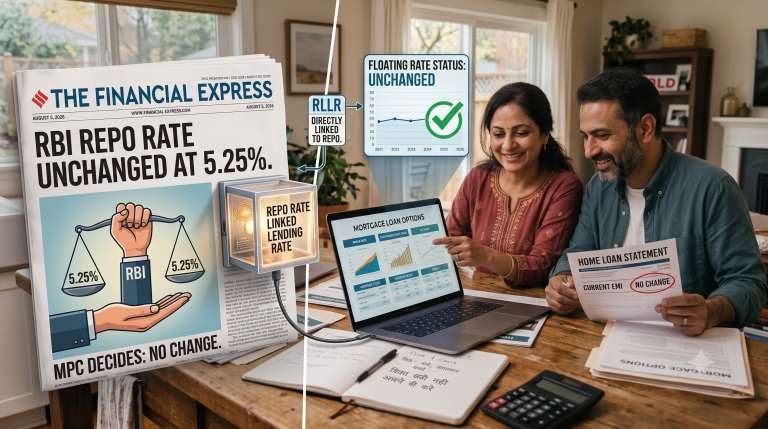
The repo rate is the rate at which the Reserve Bank of India (RBI) lends money to commercial banks. When the RBI increases the repo rate, banks find it more costly to borrow funds, and they often pass this cost on to borrowers by increasing the home loan interest rate.
In 2026, the RBI has reduced the repo rate, which has reduced the home loan interest rates significantly.
Banks in India offer loans based on two major benchmarks:
Borrowers must carefully check whether their loan is on MCLR or RLLR, because it makes a big difference in long-term cost.
Suggested read: MCLR BASE RATE
Most borrowers prefer floating home loan rates, since the RBI’s stance is expected to remain stable or slightly accommodative.
Suggested read: Fixed Home Loan Interest Rate
Your credit score is perhaps the most decisive factor in determining your rate.
Let’s look at the home loan interest rates comparison 2026 across major banks:
| Bank | Starting Home Loan Interest Rate (p.a.)* |
| SBI Home Loan Interest Rate 2026-27 | 7.250% onwards |
| HDFC Home Loan ROI 2026-27 | 8.15% onwards |
| ICICI Home Loan Interest Rate Today | 8.50% onwards |
| Axis Bank Home Loan Interest Rate | 8.00% onwards |
| Kotak Home Loan Rate 2026-27 | 7.70% onwards |
| Bank of Baroda Home Loan Interest Rate | 7.20% onwards |
| PNB Home Loan ROI 2026-27 | 7.50% onwards |
| Other PSU Banks (Central Bank, BOM, IOB, BOI) | 7.35% onwards |
The starting rate is for best-case borrowers (excellent credit, salaried, low risk). Actual rate varies.
This table shows how public sector banks like SBI, PNB, and BoB are leading with the lowest home loan interest rate in India 2026, while private banks tend to start higher but may offer faster processing.
When comparing home loan interest rates in 2026, many borrowers assume that the bank’s advertised rate is the one they’ll receive. In reality, the final SBI home loan interest rate 2026, HDFC home loan ROI, or ICICI home loan interest rate today depends on multiple personal and financial factors.
Banks consider your credit score as a snapshot of your repayment discipline. A score of 750 and above is usually required to qualify for the best advertised slabs, such as SBI 7.50% or Kotak home loan rate 7.99%. If your score falls between 650 and 700, banks may either charge you higher interest (8.75%–9.50% range) or reject your application. Improving your score by clearing debts, lowering credit utilization, and avoiding defaults before applying for a home loan can directly save you lakhs.
Another critical factor is how much you borrow and for how long. Smaller loan amounts (for example, under ₹35 lakh) often get lower rates — as seen in ICICI Bank slabs — while larger loans attract higher slabs due to higher risk. Similarly, shorter tenures may come with slightly lower ROI because banks recover principal faster, whereas 20–30 year tenures expose them to more interest rate volatility.
Banks also differentiate based on borrower categories. For instance, women applicants often receive a 0.05% concession on rates, so an HDFC home loan ROI 2026 of 7.90% for a man could be 7.85% for a woman. Similarly, salaried borrowers, especially those working with government or reputed private companies, are considered low-risk and get better rates than self-employed professionals.
Your property itself influences the rate. Ready-to-move flats in metro cities are low risk because they already have approvals, occupancy, and resale potential. Under-construction properties, rural properties, or those in non-approved projects may lead to higher ROI or stricter eligibility conditions.
Finally, banks assess the stability of your income. Public sector employees often get special concessions — for example, SBI Privilege Home Loan or PNB Pride Scheme for government staff. For self-employed borrowers, lenders add a small premium (often 0.10%–0.25%) because of income variability.
One of the best ways to visualize the impact of different interest rates is by using an EMI calculator. With just three inputs — loan amount, tenure, and rate of interest — you can immediately see how your monthly EMI and overall repayment changes.
Let’s compare a loan of ₹50 lakh over 20 years across three banks:
This comparison highlights a crucial insight: a 1% difference in rates increases your monthly EMI by ₹3,600 and your total repayment by nearly ₹9 lakh over 20 years.
Now imagine if you borrowed ₹1 crore instead of ₹50 lakh. That same difference in interest rate would nearly double your additional outgo to ~₹18 lakh. This is why financial planners emphasize that borrowers must prioritize interest rate savings over perks like “free credit card” or “holiday vouchers” that some banks use as marketing gimmicks.
An EMI calculator also helps you test “what-if” scenarios. For example:
By experimenting with these numbers, you’ll realize why choosing the lowest home loan interest rate in India 2026 is only half the battle – disciplined prepayments and smart tenure choices matter just as much.
A common question for borrowers is: Should I opt for floating or fixed interest rates? The answer depends on both market conditions and personal preference.
The floating vs fixed home loan rate debate often leans towards floating because most Indian borrowers are risk-tolerant when it comes to rate volatility. A floating rate loan is tied to the repo-linked lending rate 2026-27 or MCLR, meaning it changes when the RBI adjusts repo rates.
Advantages of floating rates:
Disadvantages:
In contrast, fixed home loan rates remain constant during the loan tenure (or for a defined initial period), they start higher.
Advantages:
Disadvantages:
Given the current RBI stance, most experts suggest floating rates in 2026, since repo rates are expected to stay moderate. However, if you strongly value certainty, a fixed rate may make sense even if it costs more.
Even with so many banks advertising competitive slabs, securing the lowest home loan interest rate in India is not automatic. It requires preparation, negotiation, and strategic timing.
A small boost in your credit score can shift you into a better slab. For example, increasing your score from 730 to 760 could mean the difference between an ICICI home loan ROI of 9.55% and an ICICI home loan ROI of 8.75%. Start by checking your score, paying off outstanding credit cards, and ensuring no errors are in your credit report.
Banks often announce special schemes during Diwali, Navratri, or the New Year. These may include:
For example, the SBI home loan interest rate today could temporarily drop below 7.50% during such campaigns.
Many borrowers don’t realize that processing fees are negotiable. On a ₹50 lakh loan, even saving 0.25% in processing fees can mean ₹12,500 saved upfront. PSU banks like PNB and BoB are often more open to negotiation, especially if you have multiple offers.
If you already have a loan, don’t assume you’re stuck. You can transfer your loan to another bank offering a lower rate. For instance, switching from an HDFC home loan with an ROI of 9.35% to an SBI home loan with an interest rate of 7.50% could reduce your EMI significantly. Balance transfer may include some charges, but the savings over a long tenure often justify the switch.
Sometimes, choosing a repo-linked lending rate 2026 product instead of an MCLR product reduces your rate by 0.25%–0.50%. Similarly, opting for a shorter tenure, if you can afford higher EMIs, reduces your total interest burden.
Choosing a home loan in 2026 isn’t just about picking the bank with the flashiest advertisement. It’s about carefully evaluating the SBI home loan interest rate 2026, HDFC home loan ROI 2026, ICICI home loan interest rate today, and others — and then understanding how your profile fits into each lender’s slab.
Here’s a practical checklist for 2026 borrowers:
By following this checklist and the insights shared in this blog, you’ll be in a strong position to not only compare but also secure the best home loan interest rates in 2026, ensuring your dream home is both affordable and financially sustainable.
SBI: 7.50%–8.70%, HDFC: from 7.90%, ICICI: from 8.75%, BoB/PNB: ~7.45%–8.00%.
PSU banks like SBI, PNB, and BoB start around 7.45%–7.50%, if you meet eligibility.
Rates move with RBI repo rate and are usually reset quarterly by banks.
Fixed = stable EMI but higher start; Floating = lower start but EMI changes with market.
Keep credit score 750+, compare lenders, negotiate fees, use festive offers or balance transfer.
Get a loan in under 5 mins