Last Updated on 9th June 2026
Getting home loan is very BASIC now
Get a loan in under 5 mins

Last Updated on 9th June 2026
The government has released the first instalment of funds to beneficiaries under Pradhan Mantri Awas Yojana (PMAY) and cleared the construction of 26,400 new houses across the country.
This fresh push aims to accelerate the delivery of affordable housing for economically weaker sections and low-income families, both in urban and rural areas, under the PMAY-Urban and PMAY-Gramin schemes.
For many families who had been waiting for money to hit their bank accounts, the release of the first instalment means they can finally start or resume construction of their homes.
|
Parameter |
Details |
|
Scheme |
Pradhan Mantri Awas Yojana (PMAY) |
|
Latest action |
First instalment of funds released to beneficiaries |
|
New houses approved |
26,400 units |
|
Main categories covered |
PMAY-Urban and PMAY-Gramin |
|
Beneficiary focus |
Low-income families, marginalised communities, kutcha / weak houses |
|
Purpose of the first instalment |
Start foundation work and early construction activities |
|
Mode of payment |
Direct Benefit Transfer (DBT) into beneficiaries’ bank accounts |
|
Monitoring tools |
Digital tracking, geo-tagging of houses, and on-ground inspections |
According to recent reports, the Centre has:
Released the first instalment of PMAY assistance to eligible beneficiaries, allowing them to start construction or move to the next stage of work.
Approved 26,400 new houses, largely under the urban (PMAY-U) and rural (PMAY-G) components.
This move comes after growing pressure to finish pending houses and clear administrative bottlenecks such as delayed approvals, land issues and funding gaps. The new approvals are meant to restart the construction cycle and send a clear signal that the programme is continuing in mission mode.
State governments have also been told to:
Speed up beneficiary verification
Ensure smooth, timely fund transfer
Monitor construction on the ground to prevent misuse or delays
PMAY has separate structures for urban and rural housing, but the basic idea is similar: the government provides financial support in stages so that a beneficiary can build a pucca house.
A rural beneficiary usually gets ₹1.20 lakh in plain areas and ₹1.30 lakh in hilly/difficult regions for building a house of at least 25 sq. m.
This assistance is commonly released in three instalments tied to construction stages (for example, foundation, plinth/roof level, and completion).
Payments go directly into the beneficiary’s bank account using DBT, and construction progress is monitored digitally and through local officials.
For urban beneficiaries, PMAY has multiple verticals, including beneficiary-led construction and interest subsidy on home loans:
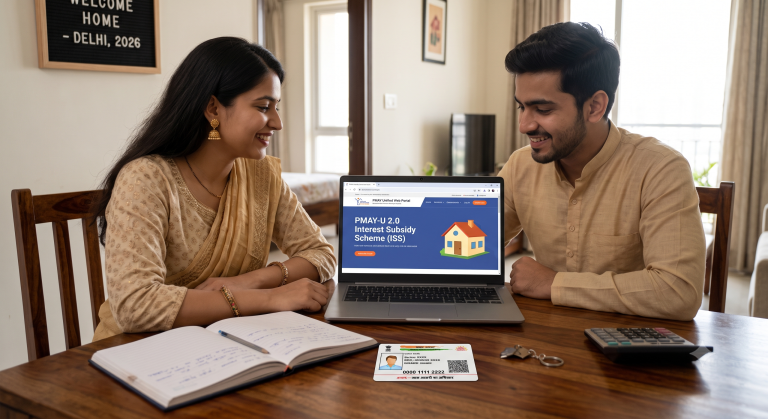
Under PMAY-U 2.0, eligible families taking a home loan up to ₹25 lakh for a house valued up to ₹35 lakh can get an interest subsidy of 4% on the first ₹8 lakh of the loan, with a maximum subsidy of up to ₹1.80 lakh, generally spread over five annual instalments.
This subsidy reduces the effective EMI and makes home ownership slightly more affordable for EWS/LIG and lower-middle-income households.
Even if you are not directly part of this batch of 26,400 houses, this update has some clear implications if you are planning to buy or build a home using PMAY support or a home loan.
Fresh funds hitting beneficiary accounts and new houses being approved show that the programme isn’t just a policy on paper. It signals that:
Pending projects are being pushed forward
Authorities are under pressure to meet revised timelines
The government is willing to keep releasing money as long as state and local agencies do their bit.
For a potential homebuyer, this improves confidence that PMAY-linked houses are more likely to reach completion.
Every fresh batch of sanctioned houses adds to the national stock of affordable homes, especially for:
Economically Weaker Section (EWS)
Low Income Group (LIG)
Families living in kutcha or semi-pucca houses
Over time, this increases the supply of low-ticket homes and can help keep prices more in check at the bottom end of the market.
The article highlights the use of digital monitoring, geo-tagging and direct transfers to track houses and money flow.
For homebuyers, that has a few benefits:
Less leakage and fewer middlemen
More transparent tracking of instalments
A clearer record that banks and housing finance companies can rely on when they evaluate your profile
With PMAY-Urban 2.0 interest subsidy available on eligible home loans and the government actively pushing new houses, it becomes easier to:
Use a regular home loan from a bank or HFC
Layer it with the PMAY subsidy, where you qualify
Bring EMIs down without waiting for a perfect “cheap property” to appear
The Centre has also nudged states to ensure that houses come with basics like electricity, water, sanitation and connectivity, so that families get livable homes rather than just walls and a roof.
In the medium term, the focus on livability improves the real value of PMAY houses, both as a place to live and as an asset you might want to refinance or upgrade later.
To check whether your name is in the list for the latest instalment, use the official portals where releases are reflected. For PMAY-G (Gramin), you can check your Instalment Details on UMANG using your PMAY-G registration details, or look up payment/release information on the AwaasSoft/RHReporting reports. For PMAY-U (Urban), you can track your application on the official PMAY MIS “Track Your Assessment Status” page (and the PMAY-U portal also supports beneficiary tracking).
For the first instalment, the exact document set can vary by State/ULB, but the official PMAY-U guidance broadly expects Aadhaar copy, bank account details, an eligibility undertaking, and land-ownership documents in case of Beneficiary Led Construction (BLC).
In most cases, Aadhaar linkage is effectively required because PMAY payments are routed via DBT mechanisms (PFMS/ABPS) and the schemes use Aadhaar for verification/deduplication. If Aadhaar details are incomplete or not linked to the bank account, instalments often get held up until seeding/verification is fixed (some exceptions/edge cases exist, but Aadhaar is the norm).
There isn’t a single fixed number of days between instalments. Instalments are generally released only after the next construction stage is achieved and verified (often using geo-tagged updates). PMAY-G guidelines target house completion within about 12 months from sanction, and PMAY-U (BLC) indicates houses should typically be completed within 12–18 months, so the gap between instalments depends on your on-ground progress and verification speed.
Changing the construction location after the first instalment is usually not allowed without formal re-approval, because the sanction/geo-tagging is tied to a specific site and project details. Design changes are sometimes possible, but only if they still meet scheme norms and you get written approval from the implementing agency/ULB/Gram Panchayat before executing changes; otherwise, the next stage verification can get blocked.
If an instalment shows “approved” but isn’t credited, first re-check bank account details and Aadhaar seeding, then ask your local implementing office for the FTO/PFMS reference and track it using the government’s FTO tracking service. If it still doesn’t resolve, raise it with the PFMS Helpdesk (toll-free/email) and share your PFMS/FTO details for faster tracing.
Get a loan in under 5 mins